
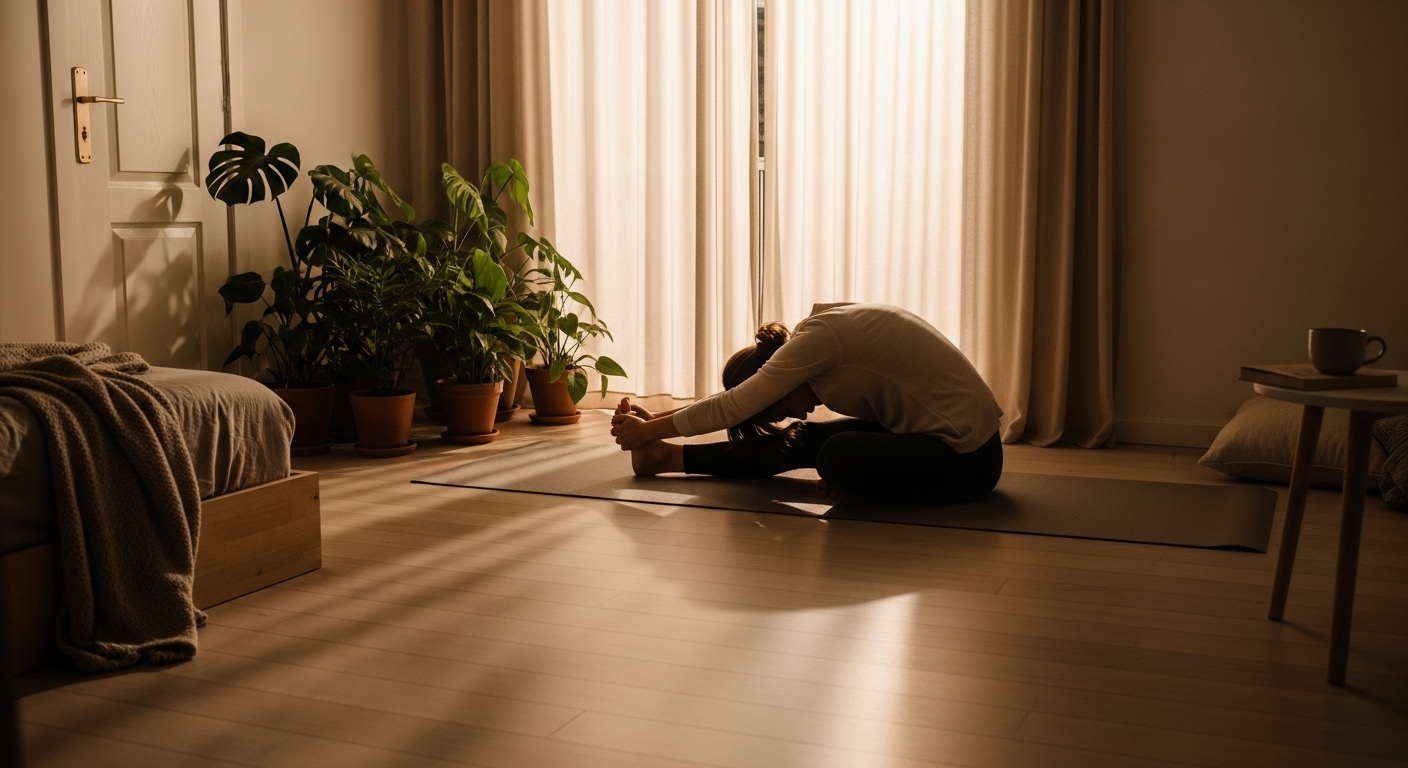
Let’s be honest for a second — most of us don’t “accidentally” wake up with great posture. We don’t magically sit like ballerinas. We don’t glide like pilates instructors. Most of us are hunched, scrolling, laptop-curved, shoulder-clenched adults who are trying to get their lives together while also trying to be productive functional humans. This is exactly why adding a daily stretch routine to improve posture and flexibility is one of the most realistic wellness upgrades normal people can actually stick to.
If you ask me — the older I get, the more I realize flexibility and posture are not superficial “aesthetic” things. They directly impact stress, pain, breath, mood, and how confidently I move through my actual real life. And the best part? You don’t need to be flexible to start a daily stretch routine to improve posture and flexibility. That’s the whole point. You build it like a skill. Brick by brick. Breath by breath. And it compounds quietly — like interest — but for your spine.
Why posture matters more than we think
Most people don’t realize posture isn’t one big dramatic thing you fix in a single moment. Posture is the sum of millions of tiny default positions you repeat throughout your day. How you sit. How you type. How you breathe. How long you hold tension in your neck when Slack notifications flood you like confetti.
Here’s the tricky part — poor posture becomes familiar posture. Your brain thinks it’s the “normal” default. So when you intentionally practice a daily stretch routine to improve posture and flexibility, you’re not just stretching muscles… you’re literally retraining what your brain believes relaxed should feel like.
What a good daily stretch routine should actually do
- Reduce neck and shoulder tension from screens
- Open your chest + upper back so you stop living in “tech neck” mode
- Improve hip mobility (sitting basically shortens your body like a folding chair)
- Increase circulation + breath capacity
- Improve muscle recovery from workouts
And this is the part I love — it doesn’t take forever. You can literally do most of it on your bedroom floor or on your living room rug in 10–18 minutes.
A realistic 12–18 minute daily stretch routine
This is the routine I recommend if you want a daily stretch routine to improve posture and flexibility — and you want it to be something that fits even in messy seasons.
Step 1: Cat / Cow (90 seconds)
This wakes up the spine gently and restores fluidity. Move slow. Close your eyes. Breathe through it.
Step 2: Chest Opener Stretch (1–2 minutes)
Clasp your hands behind your back (or use a strap/towel) and lift slightly. This counters The Laptop Curve™.
Step 3: Hip Flexor Lunge (2–3 minutes per side)
Long holds. Slow exhales. This is where you start to feel your body release the “sitting grip.”
Step 4: Figure Four / Pigeon Variation (1–2 minutes per side)
This is where all the emotional tension you’ve been storing for 18 years magically shows up like “surprise.” Normal.
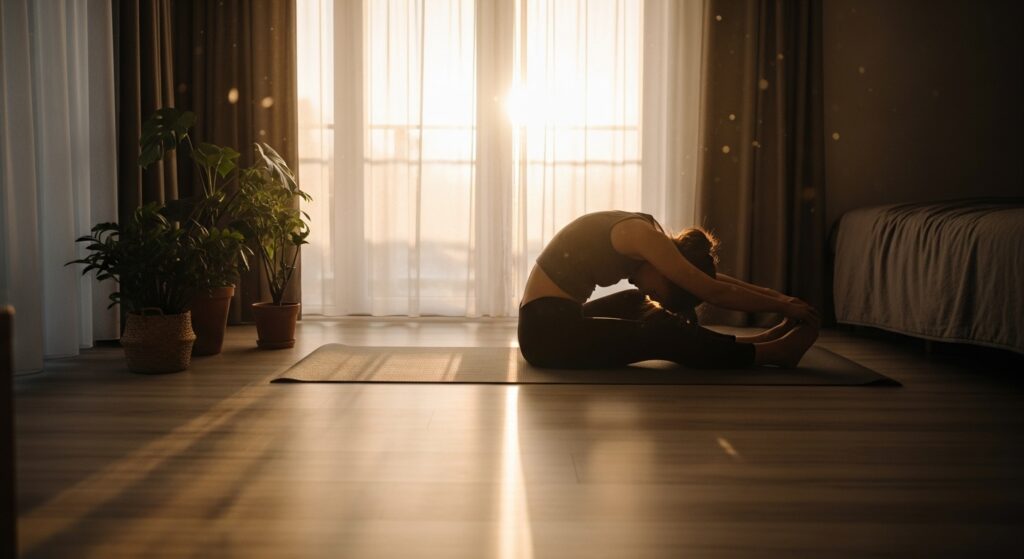
Step 5: Seated Forward Fold (2 minutes)
Try to relax your neck. Soften your jaw. Let gravity do the work.
Step 6: Thoracic Twists (1 minute per side)
This is my personal favorite part of this daily stretch routine to improve posture and flexibility because I swear this is where you literally feel your nervous system calm down.
Step 7: Low Back Decompression (2 minutes)
Legs up on chair, couch, or wall. Breathe slow. Everything uncompresses in a way that instantly feels like peace.
Why morning stretching hits different
I’ve tested morning vs evening. Most of the time — morning wins, not because it’s “morally better,” but because once chaos starts… it doesn’t stop. Your day becomes a series of micro fires, tasks, interruptions, Slack chaos, tiny emergencies, and little self-betrayals (like “I’ll do it later”).
But if you do this daily stretch routine to improve posture and flexibility before you even start your first task, you begin the day with your body in the right direction instead of trying to fix it at the end when you’re exhausted.
How long until results?
Two weeks. I know that sounds fast. But when you stretch daily — the nervous system adapts surprisingly quickly. The real shift most people feel isn’t physical first. It’s nervous system softness. Less tension. Less neck clenching. Less subconscious bracing.
Small supportive habits that compound this routine
- Switch your phone to airplane mode at night
- Breathe through your nose when stretching — not mouth breathing
- Keep a water bottle near you 90% of the time
- Keep a yoga strap / towel in visible reach
- Don’t stretch angry, stretch curious
How to stay consistent when motivation disappears
You will have days where you don’t feel like doing this. We all do. But you don’t need motivation. You just need a promise. A rule. A baseline. 10 minutes is enough. Consistency beats intensity. Every single time.
Final thoughts
Your spine is carrying you for your entire life. Your nervous system is processing more stimulation than any generation in human history. You deserve a way to release tension daily. That’s why building a daily stretch routine to improve posture and flexibility is not a luxury — it’s a strategy for a softer, calmer, better functioning future self.
Frequently Asked Questions (FAQs)
Should I stretch before or after workouts?
Before workouts, focus on dynamic movement-based mobility. After workouts (or separately), do long slow holds like in this routine. Your daily stretch routine to improve posture and flexibility can be done standalone in the morning or evening — or after training.
How long does it take to see posture improvement?
You’ll typically feel noticeable reduced tension within 10–14 days. Mobility gains continue for months. Posture changes are gradual — but they absolutely happen when done consistently.
Can I stretch every single day?
Yes. Gentle stretching isn’t destructive. You can stretch daily safely — as long as you’re not forcing aggressive end-range positions.
Can I do this routine even if I’m not flexible yet?
100% yes. You don’t need to be flexible to start a daily stretch routine to improve posture and flexibility. Flexibility happens because you start.
Is stretching enough for pain relief?
Often yes — especially for desk posture stiffness. But if pain is sharp, severe, or persistent, a physical therapist or clinician should evaluate it. Stretching should feel relieving — not painful.